
Understanding Gender Dynamics in Livelihood Programs
- Alia Omer
- May 20, 2025
- 3 min read

Updated: May 31, 2025
Reimagining livelihoods by investigating how to shift power dynamics for minority women beyond financial inclusion in Uttar Pradesh.
Organization: The/Nudge Institute
Location: Uttar Pradesh, India
Timeline: 2023–2024
Team: 3 ethnographic researchers (with support from implementation teams and product team)
Project Brief & Context
While scaling our women-focused Graduation Livelihoods Model across Indian states, we discovered that financial inclusion alone did not guarantee empowerment—especially in regions with deeply entrenched gender norms. In-house teams, including designers, took on the role of researchers to better understand the behaviors and nuances that hinder women’s participation.
Our Intervention: Gender Dynamics Tool
A field-ready tool to map household power dynamics and gender roles- informing program decisions and initiating dialogue on income rights and shared responsibilities.
Role: Lead Researcher · Fieldwork & Ethnographic Observation · Qualitative interview · Data Synthesis · Tool Development, Program Adaptation Strategy
To investigate this, we initiated and led a gender research project in a Muslim-dominated community in Uttar Pradesh, aiming to deeply understand the lives and limitations of our beneficiaries, referred to affectionately as Didis.
Approach

In order to uncover the invisible structures of gendered responsibility and how they influenced participation in our programs- Over 2 months, I conducted immersive field research across 30 households, using a mix of:
Ethnographic observation
Informal interviews with women and their families
Participatory role-mapping (paid vs unpaid work)
Daily activity charts to track time, mobility, and agency


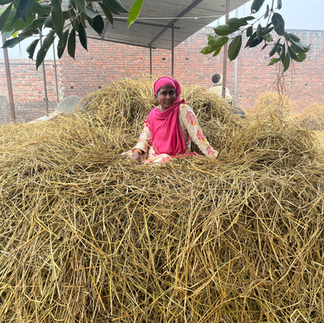

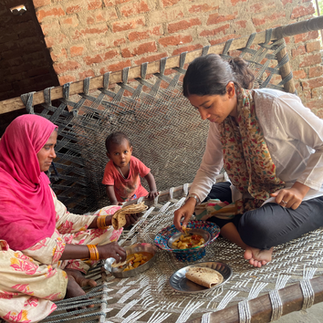
These photos capture the ethnographic research I conducted to understand rural women's daily lives—their roles, responsibilities, and relationship dynamics within the household.
Our Intervention: Gender Dynamics Tool
Our core question: How might we design livelihood programs that not only offer economic opportunities, but also shift power dynamics within marginalized households—particularly for minority women?
Insights at a Glance
Household power often depends on the woman's relationship with the male head of the family.
A woman's daily availability shifts based on the age and care needs of children or elders in the home.
This led to the creation of the Gender Dynamics Tool—a framework to assess and visualize power, roles, and agency within households.This tool:
Helped field teams understand how time, decision-making, and mobility are distributed by gender
Informed the timing and structure of our program delivery
Encouraged conversations with families around shared responsibilities and women’s rights to income
Impact
This project highlighted that inclusion is not empowerment without addressing structural inequality.
As a result:
The program is now moving towards a gender-responsive model, addressing both immediate needs and underlying power imbalances.
We initiated internal training for staff to better recognize and respond to gendered barriers.
The Gender Dynamics Tool has been integrated into the baseline assessment process across similar communities.
Challenges Faced
Entrenched power dynamics: Cultural and religious norms dictated control over important choices, so women had little say, especially about work and money.
Hidden labor: Didis were performing the majority of unpaid work (childcare, cooking, elder care), which wasn’t considered in program design.
Personal Challenges: Navigating tough terrains with limited network coverage and scarce access to resources. Being new to these communities, I was often seen as an outsider, and earning trust required patience, consistent presence, and a commitment to stay connected long after the initial engagement.
What I’d Do Differently
If I were to do this again, I would involve male family members and local community influencers earlier in the process to better understand their views and the barriers they face. Co-designing with both men and women could make behavior change more sustainable and reduce resistance to shifts in traditional gender roles.


Comments