
The Future of Coastal Resilience in West African Communities
- Alia Omer
- May 20, 2025
- 3 min read

Updated: May 31, 2025
Guiding Question
How might we enable Senegalese fishing communities to wield data about their ocean ecology as social and political power?

Overfishing, coastal erosion, and climate change are pushing artisanal fishing communities in West Africa, especially Senegal, toward poverty and displacement. Illegal and industrial overfishing, combined with weak enforcement, are depleting fish stocks, while climate shifts are disrupting ocean patterns.
In response, data and knowledge exchange between scientists and coastal communities has sparked agency and action. By 2040, this collaboration has grown into a symbolic synthetic mangrove—an infrastructure that gathers ocean and human data, translating it into tools for both scientific discovery and local empowerment. Through diverse data collection and tech-enabled storytelling, these communities now have the means to organise, advocate, and reclaim power in shaping their future.
Organization: National Oceanography Centre (NOC)
Location: United Kingdom
Timeline: April 2025
Team: 3 fellow Design Futures students, Royal College of Art (RCA)
Project Brief & Context
West African coastal communities face mounting threats from climate change, rising sea levels, and ecological degradation. These communities, deeply reliant on the ocean for food, livelihoods, and cultural identity, are often excluded from marine governance. As a result, adaptation and resilience strategies are frequently fragmented, top-down, or inaccessible.
The NOC’s ACCORD project and the wider NEMO programme seek to change this through equitable access to ocean data, capacity-building, and inclusive economic models.
This brief challenged us to translate ocean science into future-oriented strategies that improve participatory governance and empower local communities to co-design and steward their marine environments.
Our Intervention: Smart Mangrove Infrastructure for Human and Ocean Data
By 2040, what began as a knowledge-sharing initiative between scientists and coastal community members has evolved into a symbolic synthetic mangrove infrastructure—a living monument to mutual learning and resilience. This structure collects both oceanographic and human-centered data, translating it into actionable insights.
Community members use this data to advocate for their rights, manage marine resources, and build local power. Scientists, in turn, gain enriched understandings grounded in lived experience. Through diversified data collection, storytelling, and technological integration, the project empowers communities to organize, communicate, and lead change in the face of environmental and socio-economic shifts.
Role:
Researcher . Concept Development. Future Artefact Ideation & Design. Strategy & Roadmapping
Approach

Impact
Integration of Knowledge Systems: Fosters collaboration between scientific and ancestral knowledge holders.
Empowerment Through Data: Offers real-time ecological insights through accessible infrastructure.
Blue Livelihoods: Sparks new, sustainable economic activities grounded in marine stewardship.
Civic and Cultural Engagement: Embeds storytelling, art, and local customs to deepen community participation.
Ecological Resilience: The mangrove serves as both a coastal buffer and a knowledge hub.



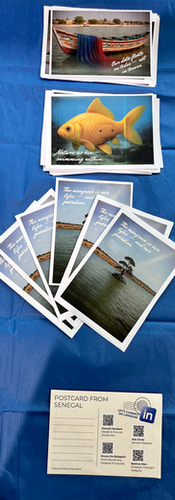


Field artifacts developed for the Ocean Futures Project.
Newspaper from the Future
AI Fish: Ocean Sensor Bot
Postcards from Senegal, 2040
Setting the Scene: Senegal, 2040
Challenges Faced
Translating Scientific Knowledge Collaborating with marine scientists revealed how challenging it can be to decode complex academic and technical information into accessible, community-relevant insights.
Time Constraints and Ambiguity The design sprint was brief and speculative by nature. Navigating uncertainty and identifying leverage points within a compressed timeframe was difficult.
Limited Community Access Not being able to directly engage with Senegalese communities made it harder to authentically incorporate local voices and perspectives.

What I’d Do Differently
This project spanned multiple systems—political, social, technological, environmental, economic, and value-driven—which made it inherently complex. In hindsight, I would focus more on designing the communication of complexity—crafting clearer narratives and more digestible formats to help external audiences connect with the richness and nuance of our intervention.


Comments