
Reoffending in Prisons 2040: The Good Place
- Alia Omer
- May 20, 2025
- 3 min read

Updated: May 31, 2025
Client: Ministry of Justice (UK)
Timeline: 2024–2025
Team: 5 members (Service Designer, Lawyer, UX Designer, UI Designer, Researcher)
Project Brief & Context
We were challenged to envision a future scenario for reducing reoffending in 2040. Our challenge was to design a long-term intervention for 2040 that supports reintegration, addresses systemic bias, and reimagines prisons not as punitive spaces but as ecosystems for rehabilitation and transformation.
Our Proposition: The Good Place
A platform that helps former drug dealers find remote jobs through AI skill-matching and VR training - supporting a dignified path to reintegrating back into society.
My role: System mapping, Research & Data Gathering, Qualitative Interviews, Ideation & Co-Creation, Synthesising Client Feedback, Service Blueprinting

Based on key future trends and foresight research, we focused on drug dealers as our primary offender cohort—representing 60% of the population and among the hardest to reform.
Interview responses:
“There’s a rapidly growing need for the probation system to introduce new tech that can take over our routine roles.”
“They are set up for the lowest level of employment, not fully integrated into society buy merely pushed to its edges.”


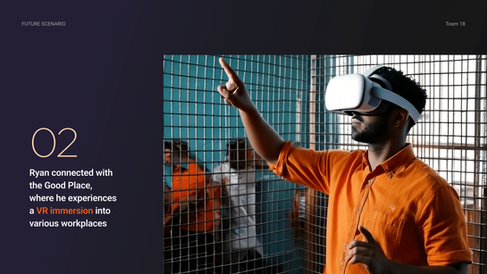




Our Proposition : The Good Place
Our core question:How can former drug dealers build stable, dignified lives in the future?
Three key insights shaped our approach:
The 4-day workweek is becoming more common across industries.
AI tools are increasingly going to shape how companies hire and manage talent.
Drug use will become less stigmatized in public discourse.
The Good Place leverages these shifts by connecting ex-offenders with remote roles via AI skill-matching, providing immersive training through VR, and offering structured pathways to paid employment.It helps:
Businesses maintain operations during shortened workweeks.
Employees enjoy better work-life balance.
Offenders access skill-building, stability, and reintegration—turning second chances into real opportunities.
This persona offers a lens to better understand how our solution works and who it’s designed for, we chose this persona to help destigmatize the hiring of offenders and to set a positive precedent for organizations to consider candidates from our cohort.

Impact
Despite limited access to stakeholders, we engaged ex-probation officers with over 20 years of experience to ground our ideas in real-world insights. Their lived experiences helped us shape a more nuanced, empathetic rehabilitation model.
Our work was well-received for its originality and sensitivity to both systemic and human factors. The Good Place sparked meaningful conversations on dignity, ethical AI, and redesigning justice systems around the needs and values of the people most affected.

This service blueprint visually represents the service process, highlighting key components, touchpoints, and interactions with our cohort.

Challenges Faced
Unclear stakeholder direction: The Ministry's brief was open-ended and lacked real-time access to stakeholders, requiring deep inference and hypothesis-based design.
Complex systemic landscape: Addressing stigma, repeat offenses, and lack of trust in the justice system through a single service design proposition was challenging, as these are complex issues that typically require distinct, targeted solutions.
Tight timelines: As the project was about imagining the future, we had very little time to explore ideas fully, which made it hard to develop detailed visuals or test with users.
What I’d Do Differently
If given more time, I would have included current or recently released inmates in co-design sessions. Their direct perspectives would have helped validate ethical concerns—especially around the unpaid work period—and ensured the solution truly reflects their realities and aspirations.


Comments